The Psychiatric Assessment
The first visit to a psychiatrist may be somewhat uncomfortable. It is often difficult to open up to a complete stranger, even one who is an expert in mental health recommended by your family physician. At the first visit, the psychiatrist will ask you to describe what has been bothering you, following a structured pattern of questions. After the history is obtained, further questions assess your mental or emotional state.
The Mental Status Examination
The Mental Status Examination (MSE) is a structured assessment clinicians use to evaluate a person's current psychological functioning — essentially the psychiatric equivalent of a physical exam. It provides a snapshot of how a person is thinking, feeling, and behaving at the time of the interview.
In psychiatry there are two complementary arms to treatment: Psychotherapy (talk treatment) and Pharmacotherapy (medication). The rest of this page covers pharmacotherapy — see the Psychotherapy page for talk therapy.
"STEPS" to Choosing Medication
An accurate diagnosis is essential before choosing any medication — without it, selecting the most appropriate medication is nearly impossible. Prescribing follows a conversation between doctor and patient, with the reason for the choice explained alongside dose, side-effects, and expected response.
- S Safe — few interactions with other drugs, not dangerous in overdose
- T Tolerated well — few side-effects short and long-term
- E Effective
- P Reasonable Price — especially if not covered by insurance
- S Simple to use — e.g. once daily, easy to reach therapeutic dose
Antidepressants
Antidepressants are believed to work by affecting brain neurotransmitters — chemical messengers carrying signals from one brain cell to the next. Most antidepressants are equally effective; selection is based on side-effect profile and physician experience. SSRIs (selective serotonin re-uptake inhibitors) are popular today: the original was fluoxetine ("Prozac"), with others including citalopram ("Celexa"), escitalopram ("Cipralex"), paroxetine ("Paxil"), sertraline ("Zoloft") and vortioxetine ("Trintellix"). SNRIs are similar and include venlafaxine ("Effexor"), duloxetine ("Cymbalta") and desvenlafaxine ("Pristiq"). Unlike SSRIs/SNRIs, bupropion ("Wellbutrin") affects dopamine and noradrenaline transmission.
Although many antidepressants exist today, none is more effective than Imipramine, the very first antidepressant — discovered accidentally in 1956 by Dr. Roland Kuhn in Switzerland while searching for a treatment for schizophrenia.
Treatment-Resistant Depression
Antidepressants often fail to relieve the feelings of depression afflicting the hopeless and suffering patient. When faced with non-response, the mnemonic OSCAR helps physicians choose their next steps wisely.
- O Optimization — confirming diagnosis, adequate dose, adherence, etc.
- S Switching to a different antidepressant (not well supported by studies — most antidepressants are equally effective)
- C Combining 2 antidepressants (also not well supported by research)
- A Augmentation — adding a non-antidepressant (e.g. Lithium, Aripiprazole, Brexpiprazole or Thyroid Hormone); well supported by research
- R Reviewing and/or Referring — examining previous steps, considering referral to a mood disorders expert
Side-Effects of SSRIs & SNRIs
When starting antidepressants, 50% of the usual therapeutic dose for the first week is recommended to reduce the risk of nausea & anxiety during initiation. After 7 days, dose is increased to the recommended therapeutic dose. It usually takes 3–4 weeks to notice improvement, and the medication is taken every day. The most troublesome side-effects during long-term treatment are sexual problems (loss of libido, delayed orgasm, erectile dysfunction), affecting up to 40% of patients. Bupropion ("Wellbutrin") and mirtazapine ("Remeron") have minimal or no sexual side-effects, as they lack direct serotonin effects.
Antidepressant Withdrawal Syndrome
Withdrawal symptoms often occur when antidepressants are discontinued suddenly rather than tapered gradually. When stopping an antidepressant, discuss tapering with your health care provider.
- F Flu-like symptoms
- I Imbalance or dizziness
- N Nausea
- I Insomnia
- S Sensory feelings (pins & needles, "brain zaps")
- H Hyper-agitation & headache
Switching Medications
Guidelines for switching antidepressants and antipsychotics were developed by psychiatrist Dr. Diane McIntosh and pharmacist Dr. Ric Procyshyn.
Pregnancy & Lactation
The website Mother To Baby provides excellent guidance on medication use during pregnancy & lactation.
Antipsychotics (Side-Effects)
Atypical antipsychotics include Zyprexa (olanzapine), Seroquel (quetiapine), Abilify (aripiprazole), Rexulti (brexpiprazole), Latuda (lurasidone) and Vraylar (cariprazine). Side-effects include akathisia, EPS (extrapyramidal symptoms — stiffness, tremor, restlessness, less commonly muscle spasms), tardive dyskinesia, metabolic changes, and sedation.
Benzodiazepines
A family of sedative medications; the best known are Lorazepam (Ativan), Clonazepam (Rivotril), and Alprazolam (Xanax). Long-acting benzodiazepines (oxazepam, temazepam) remain in the blood longer and are used as sleeping agents. Alprazolam has the shortest half-life of all benzodiazepines and has proved very difficult to discontinue — Xanax is best avoided. Although effective and fast-acting, benzodiazepines carry addictive potential, tolerance, and withdrawal effects.
Mood Stabilizers & Treatment of Mania
"Mood stabilizer" is a difficult term to define — mood stability itself is ill-defined and poorly understood. Lithium is considered the classic mood stabilizer. Anticonvulsants valproate (Epival), lamotrigine (Lamictal), and carbamazepine (Tegretol) are also considered mood-stabilizers, though they do not stabilize all aspects of mood. Certain second-generation antipsychotics (e.g. quetiapine, aripiprazole) have been called mood-stabilizers, but their role is less clear.
Lithium is the "gold standard" treatment for acute mania. Adding an antipsychotic to lithium is associated with a 20–25% increase in mania responses, though combination therapy produces more side-effects (weight gain, neurological effects, sedation).
Lithium
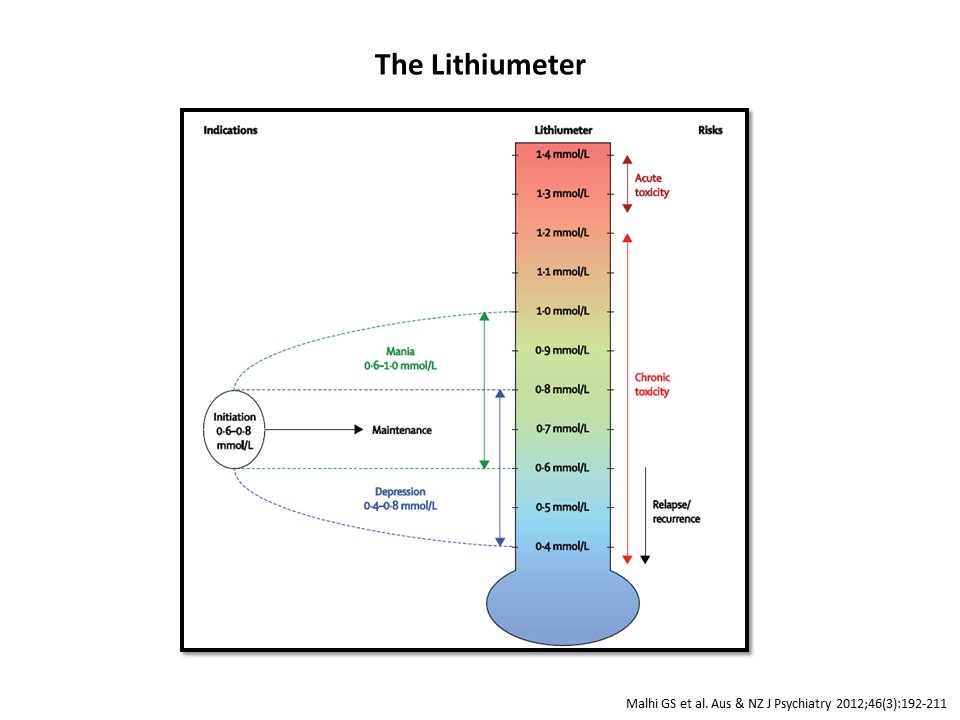
Lithium is a treatment of choice for preventing manic & depressive episodes in bipolar mood disorder, and is also used to boost the effect of antidepressants. It affects many neurotransmitter systems including serotonin. Lithium is excreted unchanged by the kidney, so drugs that reduce renal clearance can cause toxicity — always check new medications against your lithium level. Symptoms of lithium toxicity include nausea and vomiting, abdominal pain, diarrhea, tremor, weakness, and confusion.
Lithium is best prescribed as a once-daily nighttime dose (unless nausea occurs), making it easy to check the level 12 hours after the dose. Once-daily dosing may protect renal function. Serum level should be the lowest level compatible with absence of manic and depressive recurrences.
Starting & Monitoring
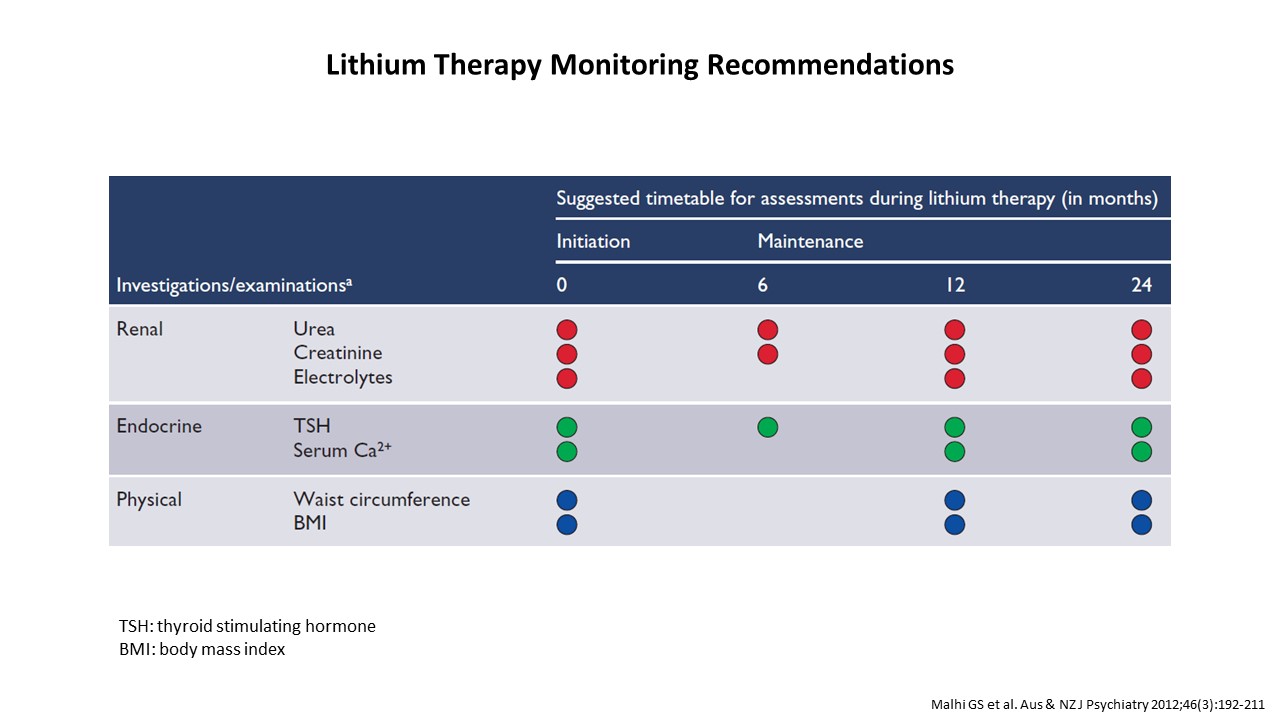
Before starting lithium, baseline thyroid hormone (TSH), kidney function tests (creatinine & GFR), and serum calcium are done. Starting dose is usually 300–900mg/day (lower in older patients). Level is checked after 5–7 days and after each dose change until stable, then every 3–6 months. A baseline ECG is considered for patients over 40 or if otherwise indicated. If GFR is below 60ml/min/1.73m², a kidney specialist should be consulted.
Drug Interactions
These medications can significantly increase lithium levels by reducing renal excretion: ACE Inhibitors (Ramipril, Quinapril, Enalapril), Angiotensin II Receptor Blockers (Losartan, Valsartan, Candesartan), NSAIDs (Celecoxib, Diclofenac, Naproxen, Ibuprofen, Aspirin — acetaminophen has minimal effect), and Thiazide diuretics.
Lithium During Pregnancy
During the 3rd trimester, increased renal blood flow lowers lithium levels — checked every 1–2 weeks during the last month to prevent relapse. At delivery, vascular volume decreases and lithium levels rise dramatically; dose should be decreased 25–50% in the week prior to expected delivery.
Epival (Valproate) Monitoring
Sometimes used to treat Bipolar Disorder. Serum levels are checked at the trough point, 12 hours after the last dose (so a morning dose is delayed until after the blood test). A low dose is used initially and gradually increased to a blood level of 50–100 microg/ml, checked 3–5 days after the most recent dose change. A therapeutic level is usually achieved around 1,500mg/day.
Monitoring Physical Health on Antipsychotics
The Canadian Schizophrenia Guidelines suggest a monitoring schedule for patients on antipsychotic medications. Swedish guidelines suggest additional tests including baseline prolactin, full blood count, renal, liver and thyroid function, and an ECG.
Hyperprolactinemia: some antipsychotics, especially haloperidol, risperidone, and paliperidone, can raise blood prolactin. Akathisia is a movement disorder — a subjective feeling of inner restlessness with mental distress and an inability to sit still, usually most prominent in the legs. It may be relieved by reducing the antipsychotic dose or adding propranolol.
Weight Gain
Weight gain is a side-effect of many medications, especially antipsychotics. Monitoring and control should begin from the moment a patient starts a medication with weight-gain potential — it is easier to prevent than to reverse.